Partition, Kaptai, displacement, and plural memory
History from 1947 to 1971
The period joins national political change to the planning and construction of the Kaptai project, displacement and compensation records, changing livelihoods, and plural accounts of 1971.
Research cutoff: 4 September 2026. Generated visuals are editorial context, not evidence.
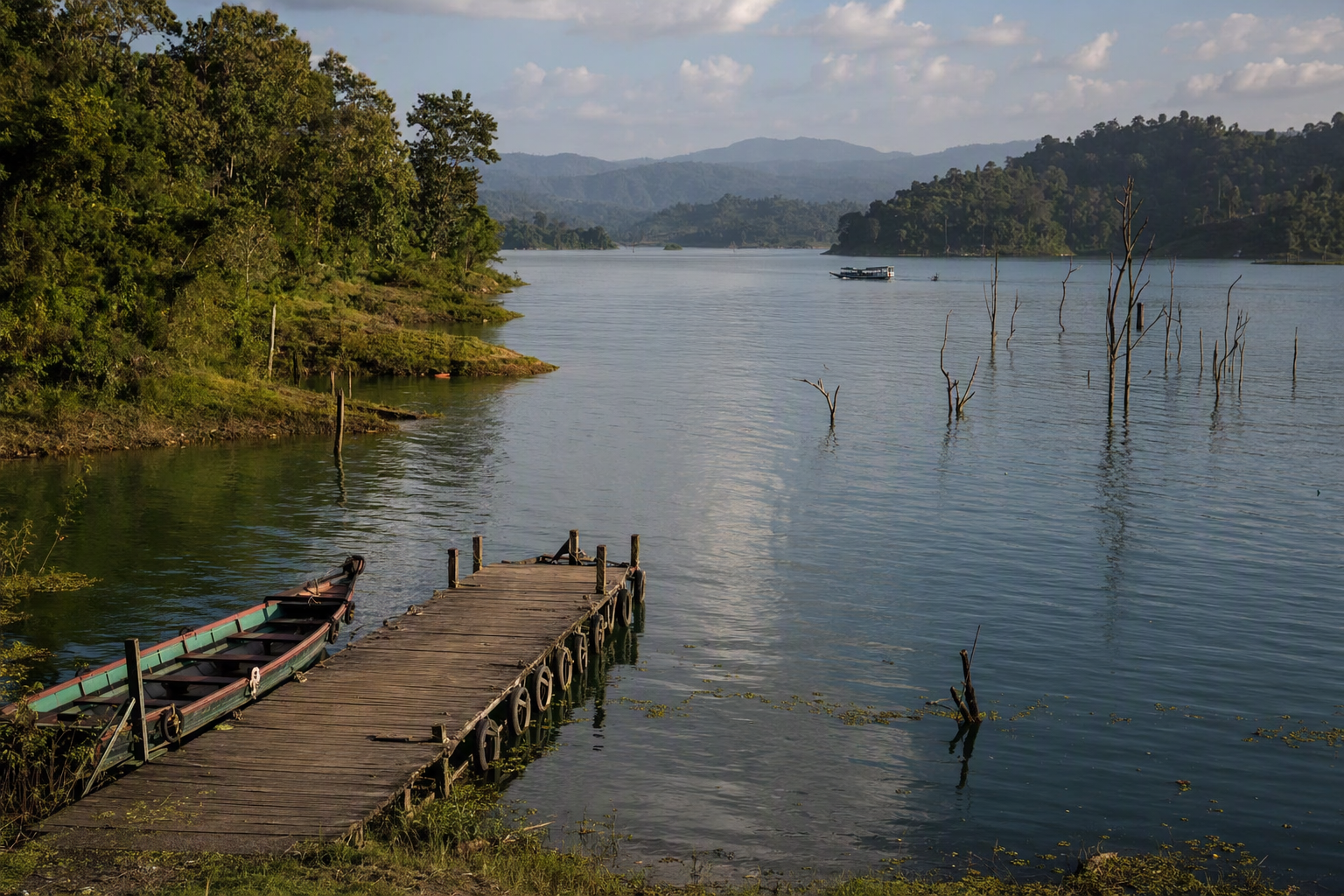 Editorial image · generated, not documentary evidence
Editorial visual
Planning, generation, filling, and completion are different dates
Separate planning, construction, commissioning, filling, and completion dates.
Generated editorial context. It is not documentary evidence and does not identify a precise person or location.
 Editorial image · generated, not documentary evidence
map-story
What the reservoir covered, and what the record cannot reconcile
Pre-reservoir land, inundation, estimated displacement, and generalized movement routes remain distinct evidence layers.
Rounded estimates, not a reconciled household register
These widely used historical estimates should not be multiplied, summed, or treated as one reproducible enumeration. Compensation machinery existed, but adequate and durable land-based rehabilitation was exceptional.
Movement across the border
Roughly 40,000 Chakmas are often said to have entered India. A formal 4,012-person cohort found in one Indian record is evidence for that cohort only, not the total migration.
Editorial visual
History 1971 Plural Record
Documented positions and experiences do not convert an elite leader’s allegiance into a community’s allegiance.
Generated editorial context. It is not documentary evidence and does not identify a precise person or location.
 Editorial image · generated, not documentary evidence
Kaptai milestones and estimates
Construction began in 1957; commissioning/generation is generally dated around 1962; filling and completion extended into 1963–64. [MS0050][MS0052]
Common estimates are about 54,000 acres of cultivable land, 18,000 families and 100,000 people displaced. They are rounded, source-specific estimates, not a verified household registry. A documented 4,012-person Assam/NEFA cohort is not total movement to India. Compensation machinery existed, but adequate durable land-based rehabilitation was exceptional. [MS0052][MS0054][MS0055]
An elite wartime stance never establishes a whole community’s allegiance. [MS0057]